Mortgage Loan Programs
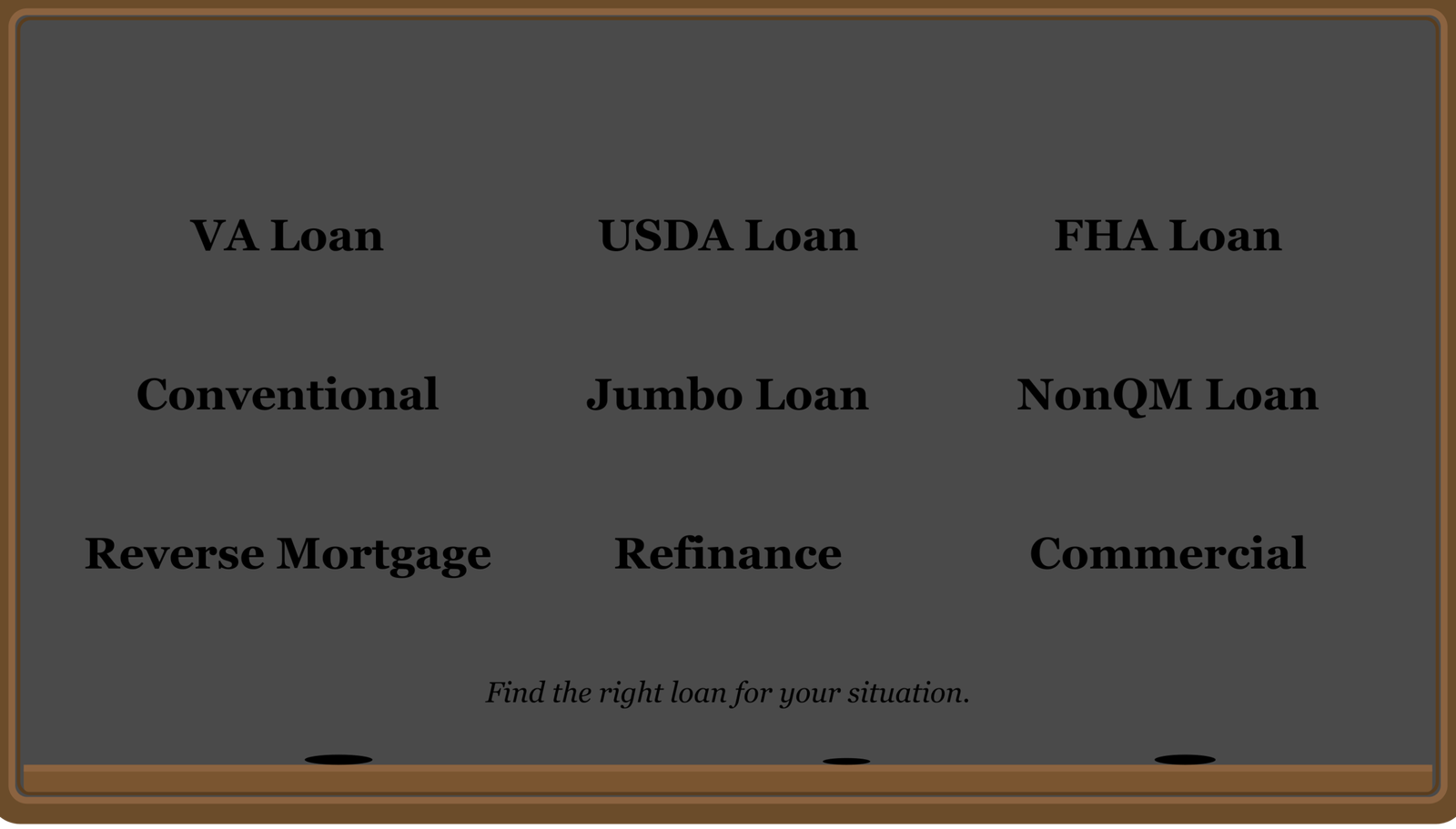
Nine mortgage loan programs cover purchases, refinances, investment properties, and situations that don't fit standard guidelines. Because every borrower's credit, income type, and goals are different, no single program fits everyone. Browse all nine below, then scroll down for a side-by-side comparison table, honest trade-offs, and answers to the most common questions.
All Nine Mortgage Loan Programs
Each card links to a dedicated program page with full details, qualification guidelines, and honest trade-offs. If you're not sure which program fits, the comparison table below gives you a quick side-by-side view.
VA Loan
Available to eligible veterans, active-duty service members, and surviving spouses. VA loans require no down payment and no private mortgage insurance. A VA funding fee may apply in most cases.
VA LOANS EXPLAINEDFHA Loans
Backed by the Federal Housing Administration, FHA loans accept lower credit scores and smaller down payments. They're a common starting point for first-time buyers and those still building credit history.
FHA LOANS EXPLAINEDUSDA Loan
Zero-down financing for buyers in eligible rural and suburban areas. USDA loans are one of the most underused programs available, and more properties qualify than most people expect.
USDA LOANS EXPLAINEDConventional Loan
The most widely used mortgage type. Conventional loans work across primary homes, second homes, and investment properties. They fit best for buyers with steady income and a solid credit profile.
CONVENTIONAL LOANS EXPLAINEDJumbo Loan
For loan amounts above conforming limits. Because jumbo loans exceed standard thresholds, they typically require stronger credit and larger cash reserves, but they cover property values that conventional financing cannot reach.
JUMBO LOANS EXPLAINEDNonQM Loan
For borrowers who don't fit traditional underwriting guidelines. Bank statement loans, DSCR loans, foreign national programs, and fix-and-flip financing all fall under this category.
NONQM LOANS EXPLAINEDReverse Mortgage
For homeowners 62 and older. A reverse mortgage converts home equity into accessible funds without requiring monthly payments. The loan is repaid when the home is sold or vacated.
REVERSE MORTGAGE EXPLAINEDMortgage Refinance
Refinancing replaces your current loan with a new one. Common reasons include lowering your interest rate, shortening your term, or accessing equity through a cash-out refinance.
REFINANCE EXPLAINEDCommercial Loans
For investment properties, mixed-use buildings, and business real estate. Commercial loans follow different underwriting standards than residential programs and are reviewed on a deal-by-deal basis.
COMMERCIAL LOANS EXPLAINEDMortgage Loan Programs at a Glance
This table gives you a quick way to compare the key parameters across mortgage loan programs. For most buyers, two or three programs will stand out as realistic options based on credit, income, and down payment. A loan officer will help you run the actual numbers once you've narrowed the list.
For county-level loan limits, the FHFA conforming loan limit data shows exact thresholds by area, since limits vary in higher-cost markets.
| Program | Min. Down Payment | Min. Credit Score | Key Feature | Mortgage Insurance |
|---|---|---|---|---|
| Conventional | 3%* | 620 (typical) | Works for primary, second home, and investment | Required if less than 20%* down; removable |
| FHA | 3.5%* (580+ score) | 500 (10%* down) | More flexible credit standards | Required for life of loan in most cases |
| VA | 0%* | No published minimum | No PMI; eligible service members only | None (funding fee may apply) |
| USDA | 0%* | 640 (typical) | Zero-down for eligible rural and suburban areas | Annual fee; lower than FHA MIP |
| Jumbo | Varies by lender | 680 to 720+ (typical) | Covers loan amounts above conforming limits | Varies by lender |
| NonQM | Varies by product | Varies by product | Bank statement, DSCR, foreign national, fix-and-flip | Varies by product |
| Reverse Mortgage | N/A (62+ only) | No minimum | Converts equity to funds; no monthly payment required | MIP applies |
| Refinance | N/A (equity-based) | Depends on program | Rate reduction, term change, or cash-out | Program-specific |
| Commercial | Varies by deal | Varies by deal | Investment, mixed-use, and business real estate | N/A |
Self-Employed or Complex Income?
Standard programs rely on W-2s and tax returns to verify income. Since tax returns often understate what self-employed borrowers actually earn, NonQM programs offer documentation alternatives. Bank statement loans, profit-and-loss qualifications, and asset depletion methods all exist for this reason. Also, the CFPB's homebuyer resource center provides additional context on comparing loan options and understanding what lenders look at during underwriting.
Honest Trade-offs to Understand
Having nine programs available is genuinely useful. But more options also mean more variables to weigh. Here's an honest look at both sides.
- A better fit for your credit profile and income type
- Lower monthly cost when the right program is matched
- Access to zero-down financing if you qualify for VA or USDA
- A path forward for self-employed or non-traditional income borrowers
- Flexibility across property types, loan sizes, and purchase goals
- More programs means more variables to compare, and more room for confusion
- Some programs carry mortgage insurance that adds to monthly costs
- Lower down payment options often mean higher long-term costs
- NonQM programs typically carry higher rates than conforming alternatives
- Choosing the wrong program can affect approval odds and total cost significantly
Not Sure Which Program Fits?
A quick look at your credit, income, and goals is all it takes to narrow the list. Use our mortgage calculator to run some numbers first, or ask a loan officer directly.
Ask a Real QuestionA Real Borrower Scenario
Two Incomes, Two Different Loan Paths
Jamie and Derek were pre-approved through their bank for a conventional loan. Derek earns a W-2 salary, so his portion of the application moved quickly. But Jamie runs her own business, and her tax returns showed lower income than she actually deposits each month.
After one conversation, they learned about a bank statement NonQM option that qualified Jamie on 12 months of deposits instead of tax returns. As a result, both incomes went on the application, their purchasing power increased significantly, and they closed on a home that wouldn't have been reachable through a single-program approach.
This scenario plays out regularly for self-employed borrowers. If a standard program isn't working, it's worth asking whether a NonQM program is a better fit before assuming your options are limited.
Specific Mortgage Loan Programs
Most buyers don't need to evaluate all nine programs in depth. These highlight the situations where one program clearly makes more sense than the others.
You have VA eligibility. VA loans are one of the strongest programs available for qualifying buyers. Because they carry no private mortgage insurance and allow zero down, they often produce the lowest monthly payment of any option. If you haven't confirmed eligibility, that's the first step worth taking.
Your credit score is below 660. FHA loans are typically more workable at lower credit scores than conventional alternatives. However, FHA mortgage insurance often stays for the life of the loan, so it's worth running both scenarios if your score is on the boundary.
You're buying in a suburban or rural area. USDA loans cover a much wider geographic footprint than most buyers realize. If zero-down financing matters and the property falls in an eligible area, USDA often produces a better monthly cost than FHA with similar credit requirements.
The purchase price exceeds conforming limits. Jumbo loans cover property values that conventional financing cannot reach. Since jumbo programs follow their own guidelines, approval criteria vary more widely between lenders, and stronger reserves are typically required.
Get Honest Answers From Someone Who Knows
Choosing between mortgage loan programs is genuinely confusing, and reading more pages doesn't always resolve it. A real conversation with a loan officer will. No pressure, no application required.
Ask a Real QuestionFAQs Mortgage Loan Programs
The right program depends on your credit score, income type, available down payment, and the property you're buying. Because every borrower's profile is different, a loan officer will compare your specific numbers against each program's guidelines before recommending anything. So the most reliable answer comes from running your actual file, not estimating from a table.
Government-backed loans (VA, FHA, USDA) are insured or guaranteed by a federal agency, which allows lenders to offer more flexible qualification terms. Conventional loans follow Fannie Mae or Freddie Mac guidelines and generally reward stronger credit with lower long-term costs. However, conventional loans allow mortgage insurance to be removed once you reach 20% equity, while FHA mortgage insurance often stays for the life of the loan.
Each program sets its own minimum. FHA loans allow scores as low as 500 with a larger down payment. Conventional loans typically require 620 or higher. VA loans have no published minimum, though most lenders apply their own overlays. NonQM programs vary widely by product type, and some have no traditional credit score requirement at all.
Yes, and you should. A good loan officer will show you side-by-side breakdowns of programs you actually qualify for. That way you can compare monthly costs, down payment requirements, and long-term trade-offs before committing to anything. There's no obligation to apply just because you ask for a comparison.
Self-employed borrowers, real estate investors, and those with complex income often qualify through NonQM programs. Bank statement loans, DSCR loans, and asset-based options exist specifically for situations where tax returns don't reflect actual earnings. If a standard path isn't working because of income documentation, that's the next conversation worth having with a loan officer.
Rates, Terms, and Disclosures
*Advertising Disclosure. The down payment percentages shown in the program comparison table above are minimum advertised figures and constitute trigger terms under the Truth in Lending Act (TILA) / Regulation Z. Accordingly, the following full disclosure applies.
Example based on a purchase price of $412,371, with a down payment of $12,371 (3%*), resulting in a loan amount of $400,000. Interest rate: 6.500%. Annual Percentage Rate (APR): 6.750%. Loan term: 30 years (360 monthly payments). Estimated monthly principal and interest payment: $2,528. Credit score assumed in this example: 740.
Private mortgage insurance (PMI) is not included in this payment example. PMI would be required on a conventional loan with less than 20%* down and would increase the monthly payment shown. Taxes, homeowners insurance, and any applicable HOA fees are not included in the payment shown above.
Rates and terms are subject to change without notice. Not all applicants will qualify. This is not a commitment to lend. Loan approval is subject to credit approval, income verification, appraisal, and program eligibility at the time of application. Down payment requirements, credit score minimums, and program availability vary by loan type and lender overlay.