Colorado FHA Loans
Flexible Financing With a Lower Down Payment
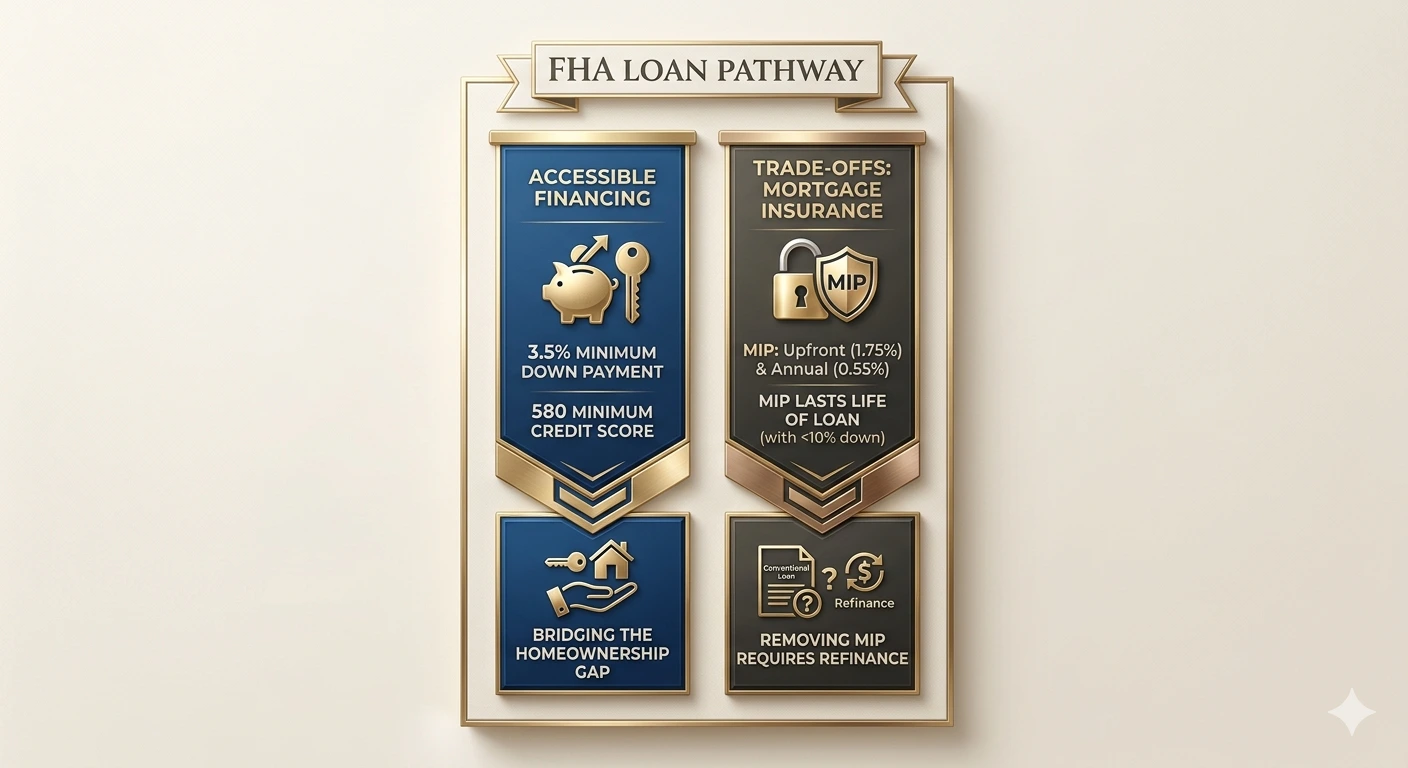
FHA loans are government-backed mortgages insured by the Federal Housing Administration. Because they allow down payments as low as 3.5%* and accept credit scores starting at 500, they’re one of the most accessible paths to homeownership. These loans work best for buyers who have limited savings, recovering credit, or both.
However, accessibility comes with trade-offs. Every FHA mortgage carries mandatory mortgage insurance that typically lasts the entire life of the loan. So before you commit, it’s worth understanding exactly what you’re signing up for.
How FHA Loans Work
The FHA doesn’t lend money directly. Instead, it insures the mortgage, which protects the lender if a borrower defaults. Because of this government backing, lenders can offer more flexible qualification standards for borrowers who might not meet the stricter requirements of a conventional loan.
You still work through a private lender or mortgage broker to apply and close. Your lender underwrites the file using HUD guidelines, and the FHA provides the insurance layer. In the current 2026 market, the FHA remains a vital entry point for buyers navigating higher home prices with limited down payment savings.
FHA Mortgage Insurance: What You’ll Pay
Every FHA loan requires two types of mortgage insurance premiums (MIP) to keep the program funded:
- Upfront MIP: A one-time fee of 1.75% of the base loan amount. Most borrowers choose to “roll” this into their total loan balance rather than paying it in cash at closing.
- Annual MIP: An ongoing monthly cost. For 2026, the standard rate remains at 0.55% for most 30-year mortgages, making FHA monthly payments more competitive than in years past.
The “Permanent” MIP Myth: If you put less than 10% down, annual MIP stays for the entire life of the loan. However, if you put 10% or more down at closing, the MIP is scheduled to drop off automatically after 11 years. For most buyers using the 3.5% minimum, the common strategy is to refinance into a conventional loan once they have built 20% equity.
FHA Loan Limits
Loan limits vary by county and are updated annually by HUD. Use the interactive drop-down below to find the 2026 FHA Loan limits for Colorado.
2026 Colorado FHA Loan Limits
| Property Type | 2026 FHA Limit |
|---|
FHA Loan Requirements
| Requirement | FHA Guideline |
|---|---|
| Credit Score (3.5% down) | 580 or higher |
| Credit Score (10% down) | 500 to 579 |
| Debt-to-Income Ratio | Up to 43% (can exceed 50% with automated approval and compensating factors) |
| Occupancy | Primary residence only |
| Employment History | 2 years of steady income, typically |
| Upfront MIP | 1.75% of base loan amount |
| Annual MIP | 0.55% for most 30-year loans |
Self-Employed or Complex Income?
FHA guidelines can work for self-employed borrowers, but documentation requirements are thorough. You’ll generally need two years of tax returns and profit-and-loss statements. If your income situation is nontraditional, take a look at our self-employed and complex income page for more detail on how different loan programs handle that.
FHA Checklist: Self-Employed & Complex Income
To move your FHA file fast in 2026, we typically need these documents upfront to verify your income and business stability:
- Tax Returns: Last 2 years of complete personal and business federal tax returns.
- Profit & Loss: A current year-to-date Profit & Loss (P&L) statement.
- Bank Statements: Business bank statements for the last 3 to 6 months.
- Business Verification: Documentation proving business ownership for at least 2 years.
Because FHA mortgage insurance is usually permanent, we also help our clients monitor their home’s value so they can refinance into a conventional loan as soon as they reach 20% equity.
Property Types Eligible for FHA Loans
FHA loans cover more than just single-family homes. The property must be your primary residence and pass a HUD-standard appraisal.
FHA Loan Pros and Cons
- Down payment as low as 3.5%*
- Credit scores accepted from 500
- Sellers can cover up to 6% of closing costs
- Gift funds allowed for the entire down payment
- Streamline refinance available later with less paperwork
- MIP lasts the life of the loan (with less than 10% down)
- Upfront MIP of 1.75% adds to loan balance
- Stricter property appraisal standards
- Primary residence only, no investment properties
- Often costlier than conventional for buyers with 700+ credit
How an FHA Mortgage Looks in Practice
Meet Sarah: First-Time Buyer, 610 Credit Score
Sarah has a credit score of 610 and $15,000 saved. She’s looking at a home listed for $300,000. Because her score is above 580, she qualifies for the 3.5%* minimum down payment.
Her down payment comes to $10,500, which leaves a base loan of $289,500. The upfront MIP of 1.75% ($5,066) is financed into the loan, bringing her total loan amount to approximately $294,566.
At a 6.500%* interest rate, her estimated monthly principal and interest payment is about $1,862*. With annual MIP of roughly $135 per month added on top, she’s looking at around $1,997* before taxes and insurance.
Although a conventional loan might have lower long-term costs for someone with a 740 score, Sarah’s credit makes FHA the more realistic option right now. As a result, she gets into a home with less cash upfront while she works on building her credit for a future refinance.
Mortgage Calculators & Tools
Compare FHA vs. conventional, estimate your payment, and see your real monthly cost.
Open the ToolsWhen a Different Loan Program Fits Better
FHA loans aren’t the best option for everyone. Sometimes another program will save you money or give you more flexibility.
If your credit score is 700 or higher: A conventional loan often costs less over time because private mortgage insurance can be removed once you reach 20% equity. With FHA, you’re stuck with MIP unless you refinance.
If you’re a veteran or active military: VA loans require zero down payment and have no monthly mortgage insurance at all. For eligible borrowers, it’s almost always the better choice.
If you’re buying in a rural area: USDA loans also offer zero down payment with lower mortgage insurance costs than FHA, as long as the property and your income meet USDA eligibility requirements.
Not sure which program works best? Our mortgage loan programs page walks through every option side by side.
Ready to Talk?
You probably have questions specific to your unique situation. That's exactly the kind of conversation we're here for.
No forms, no pressure, just straight answers.
FHA Loan FAQs
FHA Loan Disclaimer
Advertising Disclosure: Example based on a $300,000 purchase price with 3.5% down ($10,500) and a credit score of 610. Base loan amount of $289,500, plus financed upfront MIP of $5,066 (1.75%), for a total loan amount of approximately $294,566. Lender underwriting fee of $1,095 applies. Interest rate of 6.500% with an Annual Percentage Rate (APR) of 6.653%. Loan term is 30 years with 360 monthly payments. Estimated monthly principal and interest payment of $1,862. Annual MIP of approximately $135 per month is also required, bringing the estimated monthly obligation to $1,997 before taxes and homeowner’s insurance. PMI does not apply to FHA loans; however, both upfront and annual MIP are required as described above. Actual rates, terms, and program availability may vary based on creditworthiness, loan amount, property type, and market conditions. Not all applicants will qualify for the rates or terms shown. Taxes, homeowner’s insurance, and any HOA fees are not included in the payment estimate above. Rates and terms are subject to change without notice.