Cost of Waiting to Buy a Home
You've probably heard some version of this advice: "Wait for rates to come down." Or: "The market's too expensive right now just hold off."
It sounds reasonable. But the cost of waiting to buy a home is almost always higher than people expect, and it shows up in ways that aren't obvious until you run the numbers.
We will breaks down where that cost comes from, how to think about it honestly, and how to figure out whether waiting is the right call for your situation or whether it's quietly costing you tens of thousands of dollars.
Where the Cost of Waiting Actually Comes From
The cost isn't one thing. It's several financial forces working against you at the same time.
1. Home prices tend to go up over time
According to the Federal Housing Finance Agency (FHFA), U.S. home prices have appreciated at an average annual rate of roughly 4.5% to 5% over the past several decades. That pace varies by year and by market but the long-term direction is consistent. On a $450,000 home, 5% annual appreciation means the same house costs about $22,500 more a year from now. That's money you'd need to finance, which increases your monthly payment, your total interest, and the down payment tied to the higher purchase price.
2. Rent payments build zero equity
Every month you rent, that payment is gone. A mortgage payment splits between interest and principal and the principal portion builds your ownership stake in the property. According to the Joint Center for Housing Studies at Harvard University, national median rents have risen by roughly 25–30% since 2019. If you're paying $2,000 to $2,500 per month in rent, that's $24,000 to $30,000 per year with nothing to show for it.
3. Waiting for lower rates often backfires
Here's the part most people miss: when mortgage rates drop, buyer demand goes up. More buyers competing for the same inventory pushes prices higher. So even if you get a lower rate, you might be paying it on a more expensive house. Freddie Mac's historical data shows the 30-year fixed rate has averaged approximately 7.7% since tracking began in 1971. This means rates in the 6–7% range, while higher than the 3% anomaly of 2020–2021, are historically normal.
The Math: What One Year of Waiting Looks Like
Here's what the numbers add up to on a $450,000 home with 5% annual appreciation and rent of $2,200 per month:
| Cost Category | What It Costs You |
|---|---|
| Home price increase (5% on $450K) | $22,500 |
| 12 months of rent paid ($2,200/mo) | $26,400 |
| Lost equity from 12 months of mortgage payments | ~$5,500–$7,000 |
| Higher down payment needed (on new price) | $675–$1,125 more |
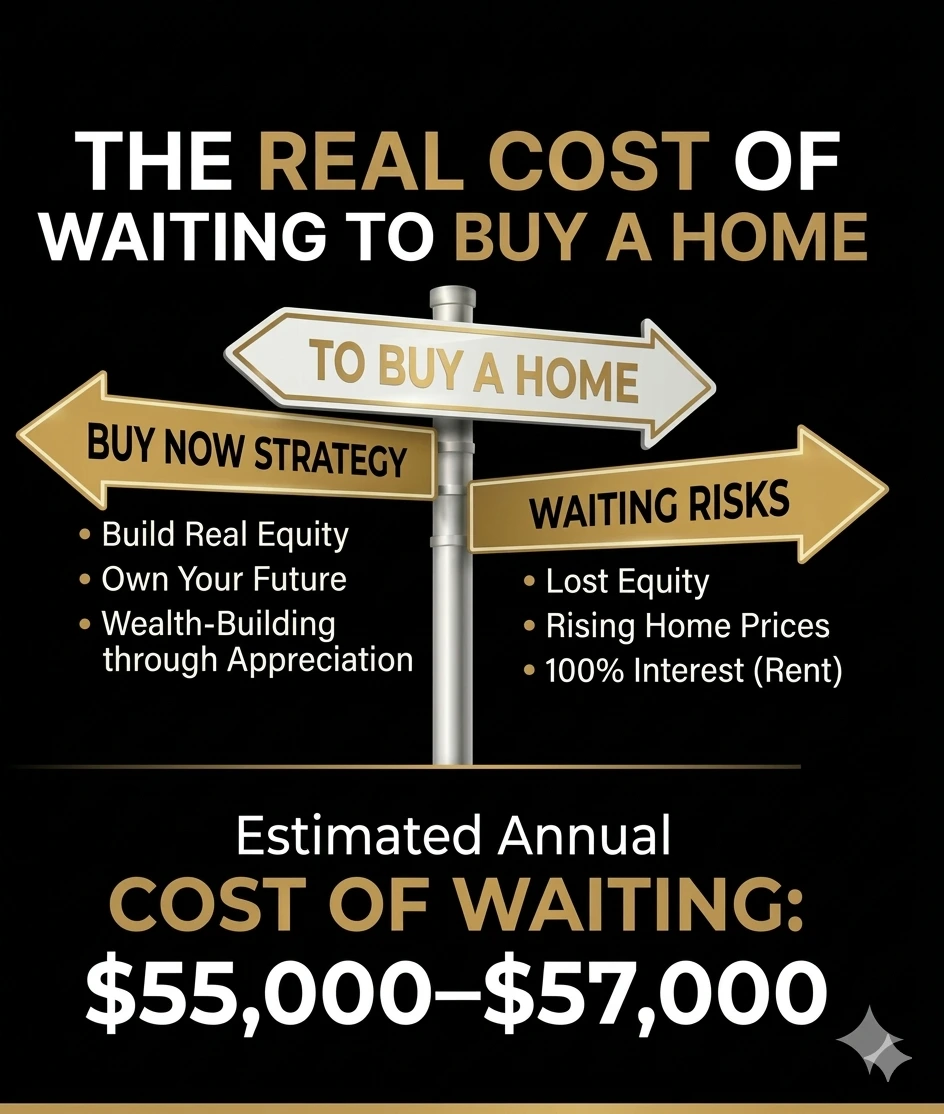
| Estimated total cost of waiting 1 year | $55,000–$57,000 |
These numbers shift depending on your local market, the home you're looking at, and your loan terms. But the direction is consistent: waiting has real financial consequences that compound over time.
Buy Now vs. Wait a Year
Buy Now at Today's Rate
- Purchase price: $450,000
- Rate: ~6.8% (current market)
- Monthly P&I: ~$2,646
- Equity after 1 year: ~$5,500 principal + appreciation
- Option to refinance into a lower rate later
Wait One Year
- Purchase price: ~$472,500 (after 5% appreciation)
- Rate: Maybe 6.2%? Maybe 7%? Unknown.
- Monthly P&I: ~$2,600–$2,780 (depends on rate)
- Equity after 1 year: $0 (you were renting)
- Rent paid during the wait: $26,400 gone
Even in the best-case scenario where rates drop a full half-percent, the monthly savings on the payment are often wiped out by the higher loan amount. And you can't get back the rent you paid while waiting.
See What Waiting Is Costing You
The numbers above are national estimates. Your real cost depends on where you're buying. We've built interactive calculators for both states we serve. Pick your state to see a personalized breakdown using current local data.
Who Should Consider Buying Now
- You have stable income and manageable debt
- You've saved enough for a down payment and closing costs (even a small one — FHA loans start at 3.5% down)
- You plan to stay in the home for at least 3–5 years
- Your rent is comparable to — or higher than — what a mortgage payment would be
- You've been pre-approved and you're just waiting for the "right time"
Who Should Probably Wait
Buying before you're ready isn't the answer either. Waiting makes sense if:
- Your income is unstable or you're between jobs
- You have high-interest debt that needs to be addressed first
- You haven't saved enough to cover closing costs or a minimum down payment
- You're planning to relocate within the next year or two
- Your credit score needs work before you can qualify for a reasonable rate
Being honest about readiness matters more than timing the market. The CFPB's homeownership resources can help you assess your financial readiness if you're not sure where you stand.
Real Example: What Waiting Cost One Colorado Buyer
A renter in the Denver metro area was pre-approved in early 2023 for a conventional loan on a $430,000 home. They decided to wait, hoping rates would drop below 6%.
By early 2024, the same neighborhood's median price had risen to roughly $455,000. Rates hadn't dropped meaningfully. Over those 12 months, they paid $26,400 in rent. The home they wanted now cost $25,000 more — requiring a higher loan amount, a larger down payment, and a higher monthly payment.
Their total cost of waiting: roughly $51,000 in lost equity and rent, with no rate improvement to show for it. They ended up buying anyway — just at a higher price.
Get Honest Answers From Someone Who Knows
The buy-now-or-wait question depends on your specific numbers — your income, savings, debt, and local market. A real conversation with a loan officer who knows your state can clear up more in 15 minutes than weeks of reading articles online.
Ask a Real QuestionIf you're still in research mode, our mortgage calculator can help you estimate monthly payments, and our full list of mortgage programs shows what's available based on your situation.
Common Questions About the Cost of Waiting to Buy a Home
It depends on how long you're willing to wait and what happens to prices in the meantime. Historically, when rates drop, buyer demand increases and home prices rise — which often cancels out the rate savings. If you're financially ready now, buying today and refinancing later when rates improve lets you lock in today's price while keeping the door open for a lower payment down the road.
It varies by market, but a rough estimate: on a $450,000 home with 5% annual appreciation, you'd pay about $22,500 more for the same house — plus $24,000–$30,000 in rent you can't recover, plus missed equity from mortgage payments you could have been making. The total can easily exceed $50,000 in a single year.
Not exactly. Renting gives you a place to live, flexibility, and no maintenance costs. But from a wealth-building perspective, rent payments don't build equity or give you any return. A mortgage payment splits between interest (which is often tax-deductible) and principal (which builds your ownership stake). Over time, the difference in net worth between renters and homeowners is significant.
It's possible, especially in certain local markets. But nationally, sustained home price declines are rare — the 2008 crash was an exception driven by widespread lending failures, not normal market behavior. If you plan to stay in the home for 5+ years, short-term dips typically recover. A home purchase is a long-term decision, not a short-term trade.
Yes. Refinancing replaces your current mortgage with a new one at a lower rate. There are closing costs involved (typically 1–3% of the loan amount), so the rate drop needs to be large enough to justify the expense. But refinancing is a well-established strategy — and it's far easier than going back in time to buy at a lower price.
Cost of Waiting Calculator Disclaimer
All figures are estimates based on general assumptions and are provided for illustrative purposes only. Home price appreciation rates, mortgage rates, and rental costs will vary by market, time period, and individual circumstance. Past appreciation trends are not a guarantee of future performance. Monthly payment estimates are based on sample loan amounts and interest rates and do not represent an offer to lend. Actual loan terms, rates, and eligibility are subject to credit approval and may differ. This content is intended for informational purposes only and does not constitute financial, legal, or investment advice. Consult a licensed mortgage professional to evaluate your specific situation.