Cost of Waiting to Buy a Home
You’ve probably heard the advice: “Wait for rates to come down” or “The market’s too expensive—just hold off.”
It sounds reasonable. But the cost of waiting is almost always higher than people expect. It shows up in ways that aren’t obvious—like lost appreciation and equity—until you actually run the numbers.
We’ll break down where that cost comes from, how to think about it honestly, and how to determine whether waiting is the right call or whether it’s quietly costing you tens of thousands of dollars.
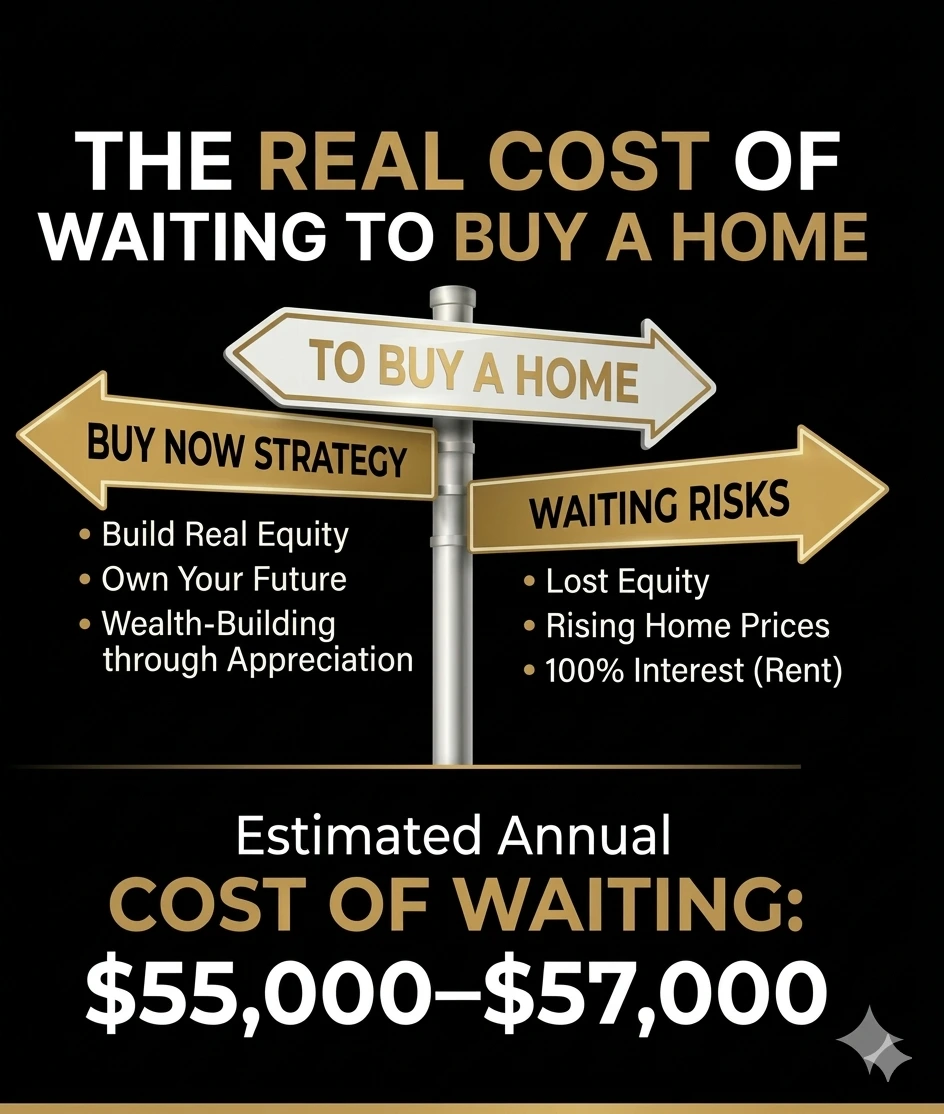
Where the Cost of Waiting Actually Comes From
The cost isn’t one thing. It’s a combination of financial forces that quietly erode your buying power while you’re standing on the sidelines.
1. Home prices rise, even in “quiet” markets
According to the FHFA House Price Index, U.S. home prices rose approximately 1.6% year-over-year as of early 2026. While we aren’t seeing the double-digit spikes of years past, steady growth remains the norm. On a $450,000 home, even a modest 2% appreciation means the same house costs $9,000 more a year from now. That is equity you missed out on and a higher loan amount you’ll eventually have to pay back.
2. Rent is a 100% interest rate
Every month you rent, 100% of that payment goes toward your landlord’s mortgage and zero toward your own wealth. As of early 2026, national median rents have stabilized at approximately $1,667 per month. Even if your rent stays flat, that’s $20,000 per year in unrecoverable costs. In contrast, each mortgage payment you make builds your ownership stake (principal) and serves as a forced savings account.
3. The “Waiting for Lower Rates” Paradox
Many buyers are waiting for rates to drop significantly before jumping in. However, history shows that when mortgage rates decrease, buyer demand surges. This increased competition typically drives home prices up, which can quickly wipe out any monthly savings you gained from a lower rate. With 30-year fixed rates currently averaging around 6.3%—well below the 7.7% historical average—buying today allows you to secure today’s price and refinance later if rates drop further.
The Math: What One Year of Waiting Looks Like
Here’s what the numbers add up to on a $450,000 home with 3% annual appreciation and rent of $2,000 per month:
| Cost Category | Financial Impact |
|---|---|
| Home price increase (3% on $450K) | +$13,500 |
| 12 months of rent paid ($2,000/mo) | +$24,000 |
| Lost equity (Principal paydown) | +$6,150 |
| Higher down payment needed | +$472 |
| Estimated Total Cost of Waiting 1 Year | $44,122 |
These numbers shift depending on your local market, the home you’re looking at, and your loan terms. But the direction is consistent: waiting has real financial consequences that compound over time.
Buy Now vs. Wait a Year
Buy Now at Today’s Rate
- Purchase price: $450,000
- Rate: ~6.8%
- Monthly P&I: ~$2,646
- Equity after 1 year: ~$6,150 principal + $13,500 appreciation
- Financial Upside: You lock in today’s price and can refinance if rates drop.
Wait One Year
- Purchase price: ~$463,500 (after 3% appreciation)
- Rate: Unknown (Market volatility)
- Monthly P&I: ~$2,550–$2,850 (depends on future rates)
- Equity after 1 year: $0 (You were renting)
- Rent paid during the wait: ~$24,000 gone
Even in a “best-case” scenario where rates drop slightly while you wait, the monthly savings are often neutralized by the higher loan amount. Meanwhile, the rent you paid is gone forever, and you’ve missed out on the first year of property appreciation.
See What Waiting Is Costing You
The numbers above are national estimates. Your real cost depends on where you’re buying. We’ve built interactive calculators for both states we serve. Pick your state to see a personalized breakdown using current local data.
Who Should Consider Buying Now
- You have stable income and manageable debt
- You’ve saved enough for a down payment and closing costs (even a small one — FHA loans start at 3.5% down)
- You plan to stay in the home for at least 3–5 years
- Your rent is comparable to — or higher than — what a mortgage payment would be
- You’ve been pre-approved and you’re just waiting for the “right time”
Who Should Probably Wait
Buying before you’re ready isn’t the answer either. Waiting makes sense if:
- Your income is unstable or you’re between jobs
- You have high-interest debt that needs to be addressed first
- You haven’t saved enough to cover closing costs or a minimum down payment
- You’re planning to relocate within the next year or two
- Your credit score needs work before you can qualify for a reasonable rate
Being honest about readiness matters more than timing the market. The CFPB’s homeownership resources can help you assess your financial readiness if you’re not sure where you stand.
Real Example: What Waiting Cost One Colorado Buyer
A renter in the Denver metro area was pre-approved in early 2023 for a conventional loan on a $430,000 home. They decided to wait, hoping rates would drop below 6%.
By early 2024, the same neighborhood’s median price had risen to roughly $455,000. Rates hadn’t dropped meaningfully. Over those 12 months, they paid $26,400 in rent. The home they wanted now cost $25,000 more — requiring a higher loan amount, a larger down payment, and a higher monthly payment.
Their total cost of waiting: roughly $51,000 in lost equity and rent, with no rate improvement to show for it. They ended up buying anyway — just at a higher price.
Ready to Talk?
You probably have questions specific to your unique situation. That's exactly the kind of conversation we're here for.
No forms, no pressure, just straight answers.
FAQs Cost of Waiting to Buy a Home
It depends on how long you’re willing to wait and what happens to prices in the meantime. Historically, when rates drop, buyer demand increases and home prices rise — which often cancels out the rate savings. If you’re financially ready now, buying today and refinancing later when rates improve lets you lock in today’s price while keeping the door open for a lower payment down the road.
It varies by market, but a rough estimate: on a $450,000 home with 5% annual appreciation, you’d pay about $22,500 more for the same house — plus $24,000–$30,000 in rent you can’t recover, plus missed equity from mortgage payments you could have been making. The total can easily exceed $50,000 in a single year.
Not exactly. Renting gives you a place to live, flexibility, and no maintenance costs. But from a wealth-building perspective, rent payments don’t build equity or give you any return. A mortgage payment splits between interest (which is often tax-deductible) and principal (which builds your ownership stake). Over time, the difference in net worth between renters and homeowners is significant.
It’s possible, especially in certain local markets. But nationally, sustained home price declines are rare — the 2008 crash was an exception driven by widespread lending failures, not normal market behavior. If you plan to stay in the home for 5+ years, short-term dips typically recover. A home purchase is a long-term decision, not a short-term trade.
Yes. Refinancing replaces your current mortgage with a new one at a lower rate. There are closing costs involved (typically 1–3% of the loan amount), so the rate drop needs to be large enough to justify the expense. But refinancing is a well-established strategy — and it’s far easier than going back in time to buy at a lower price.
Cost of Waiting Calculator Disclaimer
All figures are estimates based on general assumptions and are provided for illustrative purposes only. Home price appreciation rates, mortgage rates, and rental costs will vary by market, time period, and individual circumstance. Past appreciation trends are not a guarantee of future performance. Monthly payment estimates are based on sample loan amounts and interest rates and do not represent an offer to lend. Actual loan terms, rates, and eligibility are subject to credit approval and may differ. This content is intended for informational purposes only and does not constitute financial, legal, or investment advice. Consult a licensed mortgage professional to evaluate your specific situation.