Colorado Down Payment Options
The number one question from people exploring their down payment options is some version of: “How much do I actually need to put down?”
And the number one problem with most answers is that they either oversimplify (“Just put 3% down!”) or overcomplicate things with jargon and fine print that leaves you more confused than when you started.
We are going to take a different approach. We’re going to walk through the real down payment options available in Colorado. I will show you how different amounts change your monthly payment and total cost, and break down the assistance programs that might help. Just the information you need to figure out where you stand.
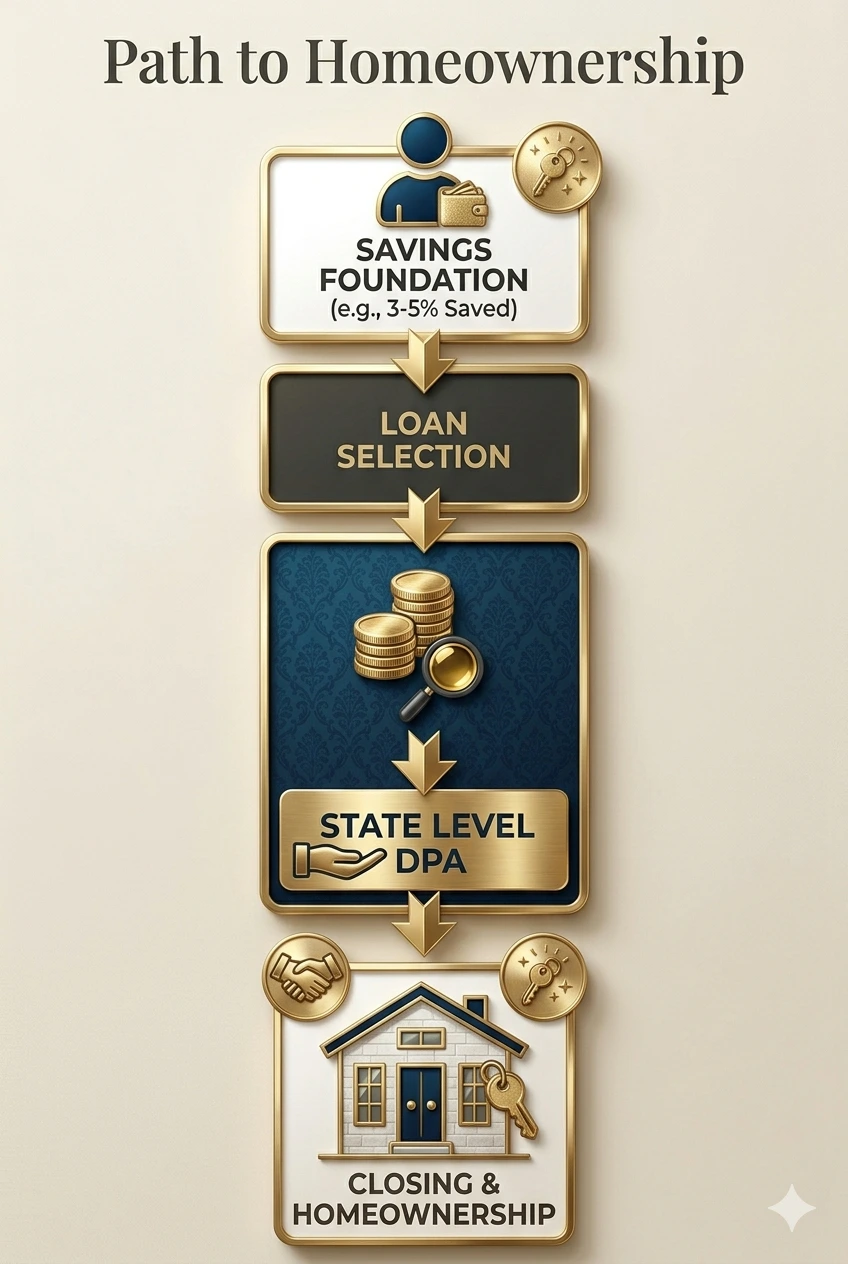
The 20% Down Myth
If you think you need 20% down to buy a home, you’re not alone. A lot of people believe this, and it keeps them renting longer than they need to.
Here’s the truth: 20% down has not been the standard for a long time. According to the National Association of REALTORS® 2025/2026 data, the median down payment for first-time buyers is 10%, the highest in decades, but still half of the “20% rule.” For repeat buyers, it’s higher (around 23%), often because they are using equity from their previous home.
You can put 20% down, and there are good reasons to do it, like lower monthly payments and eliminating mortgage insurance. But it’s not a requirement, and waiting years to save that much could mean missing out on building equity while home values continue to climb.
The real question isn’t “Do I have 20%?” It’s “Which down payment option makes the most sense for my situation right now?”
Down Payment Options by Loan Type
Different loan programs carry different minimums. Here’s a plain-language overview of the down payment options available in 2026:
Minimum Down Payments at a Glance
| Loan Type | Minimum Down | Key Detail |
|---|---|---|
| Conventional | 3% | Requires PMI below 20%; 620+ credit usually required for 3% down. |
| FHA | 3.5% | More flexible credit; MIP required for life of loan if under 10% down. |
| VA | 0% | Eligible Veterans and Active Duty only; $0 monthly mortgage insurance. |
| USDA | 0% | Rural/Suburban areas; income limits apply (CO limits up to $149,800+; FL limits up to $142,450+). |
A few things worth knowing about this chart:
- Conventional at 3%: While 620 is the floor, most competitive 3% programs look for 680+. Lower scores may require a 5% or higher down payment.
- FHA at 3.5%: Allows for scores as low as 580. If your score is between 500–579, FHA requires a 10% down payment.
- VA at 0%: The premier benefit for our military community. There is a one-time funding fee (typically 2.15% for first-time use), but no monthly mortgage insurance ever.
- USDA at 0%: You’d be surprised how many pockets in Colorado qualify (like parts of Falcon or Northern CO). In 2026, household income limits for a 1-4 person family are $130,250 across most of Colorado, with significantly higher limits in metro areas like Denver.
How Each Down Payment Option Changes Your Cost
Putting less money down gets you into a home sooner. But it also increases your monthly payment, adds mortgage insurance costs, and means you’re borrowing more. The trade-offs between down payment options are real, and they add up over time.
Here’s what the math looks like on a $425,000 home with a conventional loan at a 6.75% interest rate:
Same Home, Different Down Payments
| 3% Down | 5% Down | 10% Down | 20% Down | |
|---|---|---|---|---|
| Down Payment | $12,750 | $21,250 | $42,500 | $85,000 |
| Loan Amount | $412,250 | $403,750 | $382,500 | $340,000 |
| Monthly P&I | $2,674 | $2,618 | $2,481 | $2,205 |
| Est. Monthly PMI | ~$220 | ~$175 | ~$115 | $0 |
| Total Monthly (P&I + PMI) | ~$2,894 | ~$2,793 | ~$2,596 | $2,205 |
| Cash Needed at Closing* | ~$25,500 | ~$34,000 | ~$55,250 | ~$97,750 |
*Includes estimated closing costs of ~$12,750 (approx. 3%). In 2026, Colorado buyers should budget 3%–5% for closing costs due to upfront insurance and tax escrow requirements. Property taxes and homeowner’s insurance not included in monthly figures. These are illustrations, not quotes.
Look at the difference between the 3% and 20% down payment options: you save about $689/month, but you need an extra $72,250 in cash upfront. For most people, that’s years of additional saving.
The middle ground is where most buyers land. Putting down 5–10% keeps the monthly payment manageable, reduces mortgage insurance costs compared to 3%, and doesn’t require you to drain your entire savings.
Something people forget: Your down payment isn’t the only cash you need at closing. In 2026, budget for closing costs of 3%–5% of the purchase price. Wiping out your savings to hit a higher down payment can backfire if your furnace breaks in month two, liquidity is just as important as equity.
Try Your Own Numbers
The table above uses one price point and one rate. Your situation is different. Use this tool to see how different down payment options affect the numbers on the home price you’re actually considering.
Down Payment Comparison Tool
| 3% Down | 5% Down | 10% Down | 20% Down |
|---|
These are estimates for comparison only, not a loan offer or quote. Actual PMI, rates, and closing costs vary by lender, credit profile, and loan program. Property taxes and insurance are not included.
Down Payment Assistance Options in Colorado
If coming up with the full down payment on your own feels like a stretch, Colorado has several programs that can help. These aren’t gimmicks. They’re real programs backed by state and local agencies, and thousands of Colorado buyers use them every year.
Here’s what’s available in 2026:
CHFA Down Payment Assistance
What it is: The Colorado Housing and Finance Authority (CHFA) offers assistance as a second mortgage, either as a grant or a deferred-repayment loan. You can review current details on CHFA’s website.
How much: Typically covers 3–4% of the purchase price. On a $500,000 home, that’s up to $20,000 toward your costs.
Who qualifies:
- Income Limits: For 2026, many CHFA programs have a statewide income limit of $174,440 regardless of county.
- Credit Score: Minimum of 620 required.
- Education: Must complete a free or low-cost homebuyer education course.
- Primary Residence: You must live in the home as your main residence.
The catch: Using assistance sometimes results in a slightly higher interest rate on your first mortgage. It’s a trade-off between “cash today” and “monthly cost.”
CHFA FirstGeneration Program
What it is: A specialized 2026 program for buyers whose parents did not own a home. This provides a significant boost to help build generational wealth.
How much: Up to $25,000 in deferred assistance.
The catch: Funding for these “Plus” programs is often limited and distributed on a first-come, first-served basis.
Gift Funds from Family
What it is: Most loan programs allow part or all of your down payment to come as a gift from a family member.
The rules:
- Must be documented with a signed gift letter.
- Must be a true gift with no expectation of repayment.
- Pro Tip: Avoid “mattress money.” Large cash deposits that cannot be sourced will be rejected by underwriters. If family is helping, have them wire the funds directly to the title company or document the transfer clearly.
What Most People Get Wrong About Down Payment Options
After years of working with buyers across Colorado, here are the patterns we see over and over again:
“I should put down as much as possible”
Not always. If putting 15% down means you close on the house with only $800 in your bank account, you’ve created a new risk. In the 2026 market, where repair costs have risen, a broken AC unit or a brief job disruption can quickly become a crisis.
A general guideline: After your down payment and closing costs, aim to have at least 3 months of mortgage payments in reserve. Liquidity is just as important as equity when you first move in.
“A bigger down payment always saves me money”
Usually, but not always. If you have high-interest debt (like credit cards at 24%+), you might be better off putting less down on a home and using that extra cash to wipe out the expensive debt. This often results in a much better monthly “net” cash flow.
Also, remember the PMI vs. MIP math: Conventional PMI can be removed once you hit 20% equity. With FHA, if you put down less than 10%, the insurance stays for the life of the loan, but if you put down 10% or more, it actually drops off after 11 years. Choosing the right program structure is often more important than the specific dollar amount you put down.
“I need to have the full down payment in savings right now”
If you’re 6–12 months away from buying, that’s the perfect time to talk to a lender. We can help you set a “target number.” There is a massive psychological difference between a vague goal of “saving money” and a specific goal of “saving $1,200 a month for 10 months” to hit your target.
“Down payment assistance is too good to be true”
They are legitimate programs designed to fuel the economy and homeownership. Yes, there are trade-offs, like slightly higher interest rates or a second lien, but for many, they are the only bridge between renting and owning. They aren’t a scam; they’re a tool.
Down Payment Options: Real Scenarios
Scenario 1: The Careful Saver
Profile: 720 credit score, $35,000 total savings, looking at $450,000 homes in Colorado.
The Math: Putting 5% down ($22,500) plus roughly $13,500 in 2026 closing costs (3%) equals $36,000. She would be $1,000 short and have $0 in the bank.
The Strategy: 3% down Conventional. This requires $13,500 down + $13,500 closing costs = $27,000. She closes with **$8,000 in the bank** for emergencies. The safety net is far more valuable for a new homeowner than a 2% difference in equity.
Scenario 2: The First-Timer (Assistance User)
Profile: 640 credit score, $8,000 saved, looking at $375,000 homes. Works as a nurse in Colorado.
Options: An FHA 3.5% down payment is $13,125, more than she has. CHFA down payment assistance covers 3–4% of the purchase price, which in this case brings her total needed cash within reach and covers most closing costs.
The Strategy: Use State Assistance. She gets into the home with her $8,000 largely intact. She “trades” a slightly higher interest rate for the ability to stop paying rent and start building equity today.
Scenario 3: The Veteran
Profile: 690 credit score, $15,000 saved, looking at $500,000 homes.
Options: She qualifies for a VA loan at 0% down. While there is a **2.15% VA Funding Fee**, this is rolled into the loan. Because VA loans have no monthly mortgage insurance (PMI), her payment is significantly lower than a 5% down conventional loan.
The Strategy: VA Loan, 0% down. She uses her savings to cover 2026 closing costs (approx. $15,000) or negotiates a seller credit to cover them, keeping her cash liquid.
A Simple Framework for Choosing Your Down Payment Option
Rather than following a universal rule, ask yourself these four questions to find your “sweet spot”:
1. What loan programs am I actually eligible for?
This narrows your options immediately. VA eligibility is a game-changer. Your credit score will largely dictate whether Conventional or FHA is the more cost-effective route, while your income and location determine if a 0%-down USDA loan is on the table.
2. How much cash do I have, and how much do I need to keep?
Take your total savings and subtract your estimated closing costs (3–5% of the price in today’s market). Then, subtract a “sleep-at-night” fund (ideally 3 months of expenses). What remains is your true maximum down payment. Never leave yourself “house poor” just to hit a specific percentage.
3. How does the down payment change my actual monthly cost?
Use the comparison tool above. If moving from 3% to 5% down only saves you $60 a month but costs you $9,000 upfront, ask yourself if that $9,000 would serve you better in an emergency fund or paying off a high-interest car loan or credit card.
4. What is my “exit strategy” for this home?
If this is a 3-year starter home, the long-term cost of FHA mortgage insurance is less of a factor. If this is your “forever home,” the ability to eventually drop PMI on a Conventional loan, without needing to refinance, is a massive financial advantage.
Ready to Talk?
You probably have questions specific to your unique situation. That's exactly the kind of conversation we're here for.
No forms, no pressure, just straight answers.
Frequently Asked Questions
What’s the minimum down payment to buy a home in Colorado?
It depends on the loan type. VA and USDA loans allow 0% down. Conventional loans start at 3% down. FHA loans require 3.5% down (or 10% if your credit score is below 580). Most Colorado buyers put somewhere between 3–10% down.
Can I buy a home with no money out of pocket?
It’s possible in some situations. VA-eligible buyers can put 0% down, and if the seller contributes toward closing costs, out-of-pocket costs can be very low. FHA and conventional buyers can layer down payment assistance options with seller concessions to reduce cash needed. But “no money out of pocket” is rare in practice. Most buyers need at least some cash for things like earnest money, inspections, and incidental costs that come up during the process.
Do I have to pay PMI if I put less than 20% down?
On conventional loans, yes. PMI is required below 20% down but can be removed once you reach 20% equity (and automatically drops at 22%). On FHA loans, mortgage insurance works differently and stays for the life of the loan if you put down less than 10%. VA loans don’t have monthly mortgage insurance at all.
How do Colorado down payment assistance programs work?
Most programs provide a second loan or grant that covers part or all of your down payment. CHFA is the largest program in Colorado. You apply through a participating lender (not directly through CHFA), and the assistance is layered on top of your first mortgage. There are income limits, purchase price limits, and education requirements. Some programs need to be repaid when you sell or refinance; others are forgiven over time or structured as grants.
Where can I learn more about the homebuying process?
The CFPB’s homebuying resources are a solid starting point for understanding mortgages, costs, and your rights as a borrower. For Colorado-specific down payment options and assistance programs, CHFA’s website is the most current source for income limits and availability.
Is it better to put more money down or keep cash in savings?
There’s no single right answer. A larger down payment reduces your monthly cost and may eliminate mortgage insurance. But draining your savings creates risk. Most financial advisors suggest keeping an emergency fund separate from your home purchase money. The sweet spot is different for everyone, and it depends on your income stability, other debts, and comfort level with financial risk.
Can I use money from retirement accounts for a down payment?
You can, but proceed with caution. First-time homebuyers can withdraw up to $10,000 from a traditional IRA without the 10% early withdrawal penalty (though you’ll still owe income tax on it). Roth IRA contributions (not earnings) can be withdrawn anytime without penalty. 401(k) loans are another option, but they come with repayment requirements and risks if you leave your job. Pulling from retirement is a last resort for most people, not a first choice.
Down Payment Options Disclaimer
Illustrative Examples and Advertising Disclosure: The payment comparisons, down payment figures, and cost estimates on this page are for educational and illustrative purposes only. They are not a commitment to lend, a loan approval, a pre-qualification, or an advertisement of specific loan terms. Actual loan amounts, interest rates, annual percentage rates (APR), monthly payments, and total costs will vary based on your credit profile, loan-to-value ratio, property type, occupancy, loan program, and market conditions at the time of application.
Annual Percentage Rate (APR): Interest rates referenced on this page are used solely for illustrative comparison and do not represent an offer or guarantee of any specific rate. The Annual Percentage Rate (APR), which reflects the full cost of borrowing, including applicable fees and charges, will differ from the interest rate shown and is available upon request based on your individual loan scenario. Contact our team for a personalized rate and APR quote.
Mortgage Insurance: Private Mortgage Insurance (PMI) estimates shown are approximations based on assumed credit scores and loan-to-value ratios. Actual PMI premiums vary by lender, insurer, credit score, loan program, and loan amount, and are subject to cancellation under the Homeowners Protection Act once sufficient equity is reached. FHA Mortgage Insurance Premiums (MIP) are set by HUD and subject to change. VA loans do not require monthly mortgage insurance but may include a VA Funding Fee, which varies based on service type, down payment amount, and prior use of the VA loan benefit.
Down Payment Assistance Programs: Information regarding CHFA, city, county, and other down payment assistance programs is provided for general informational purposes only and reflects program guidelines as understood at the time of publication. Program availability, income limits, purchase price limits, assistance amounts, and terms are subject to change without notice and may vary by county and funding availability. Not all borrowers will qualify. Elevation Mortgage does not administer these programs and cannot guarantee current program availability or terms. Visit chfainfo.com for the most current CHFA program information.
Calculator Results: Results generated by the Down Payment Comparison Tool on this page are estimates only, based on the inputs you provide and assumed closing costs of approximately 3% of the purchase price. Results do not constitute a loan offer, pre-approval, or pre-qualification. Property taxes, homeowner’s insurance, HOA fees, and other costs are not reflected in the monthly figures shown. Actual payments and total costs will vary.
Not Legal, Financial, or Tax Advice: The content on this page is intended for general informational purposes only and does not constitute legal, financial, or tax advice. Consult a qualified financial advisor, tax professional, or attorney regarding your specific circumstances before making financial decisions related to a home purchase.